|
This is a free software, not yet open source, to generate the barcodes discussed in the following publication:
Aguiar, A.P. (2013) Publishing large DNA sequence data in reduced spaces and lasting formats, in paper or PDF. Zootaxa, 3609, 593–600.  |
Requirements. WindowsXP, W7, or later versions. There is also a Python version.
Installation. (1) Download the file pak.zip ("download" button below); (2) Extract the folder "pak" and place it anywhere in the "C:/" drive of your computer (preferably in the folder "C:/Program files" or similar); (3) Start the program by clicking the pak.exe file.
Download and Usage

In the Table below, hover over barcode image to see an enlarged, pixel-level detail of the barcode generated by each algorithm (Attention: allow pop-ups).
Table. Barcodes, number of
bases represented in the respective sample, usage, link to respective
software, and brief explanations on what and how each software piece
works (Encoding; Barcode Generation).
Barcode sample |
bp |
Usage |
Algorithm |
Encoding |
Input |
Image type | Method |
|
80 |
Paper/PDF |
pak7.py |
Fonts |
IUPAC |
RGB | Smallest possible fonts. |
|
600 |
Paper/PDF |
pak5.py |
B&W |
ACGT |
RGB | Two B&W pixels per bp. |
|
600 |
Paper/PDF |
pak5b.py |
B&W |
ACGT |
RGB | Three B&W pixels per bp. |
|
40 |
Paper/PDF |
pak3c.py |
4 colors |
ACGT |
RGB | "Illustrative barcode" by BOLD. |
|
600 |
Paper/PDF |
pak3.py |
4 colors |
IUPAC |
RGB | Electropherogram colors; 1 pixel per bp. |
|
10K |
PDF only |
pak8b.py |
Full color |
IUPAC |
CMYK | 13 bp per pixel. |
|
10K |
PDF only |
pak4d.py |
Full color |
IUPAC |
RGB | 10 bp per pixel. Memmory intensive, but 10% faster. |
| pak4d2.py |
RGB | 10 bp per pixel. For large files (over 1 million bp). Memmory efficient, 9% slower. |
|
10K |
PDF only |
pak4e.py |
Full color |
ACGT |
CMYK | 15 bp per pixel. |
|
900 |
PDF only |
pak6c.py |
Full color |
IUPAC |
RGB | Compresses repeated bases. |
Screenshots
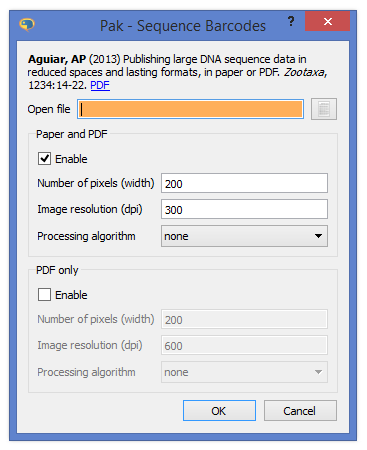
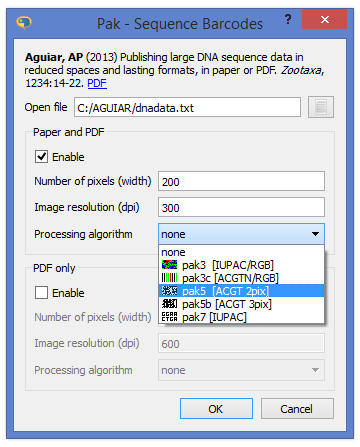
Usage Instructions
- Open file : select file containing sequence; only txt or fas (FASTA) formats accepted
- Enable : select algorithm set suitable for "Paper and PDF" or for "PDF only"
- Number of pixels (width) : max allowed value = 2000, which is close to mirror width = 170 mm with printing resolution = 300 dpi (Zootaxa limits).
- Processing algorithm : acc. to Table above; if two algorithms are selected, only the first one will be run
- OK : a) runs selected algorithm, b) saves file as TIFF image in the same directory of input file, c) displays resulting image, and d) closes the program (multiple sessions in the same run not yet possible)
- You might also want to take a look on the instructions for the Python version of pak, available here
FAQ
- Which option is the best? It depends on personal choice (e.g., if you want the barcode to be readable on the printed/paper version of the publication, do not choose any of the "PDF only" options); need of RGB vs. CYMK images (see below); sequence size or number of sequences to publish vs. level of compression wanted; and, to a minor extent, the kind of data you have: for sequences with many repeated bases (e.g., extremely long 'NNNNNN' series), the pak6c algorithm might produce the greatest compression, that is, the smallest barcode image.
- What will I need, RGB or CYMK images? It depends on which of these two formats the journal is able to handle. For example, Zootaxa can process RGB images only, and Zookeys works only with CMYK images. If you send CMYK files to Zootaxa they will be first converted to RGB (changing pixels considerably) and only then the PDF or the printed matter will be issued - all pixels will be converted from one format to the other, and since these two formats are not really equivalent, losses will occur. The same problem would occur with RGB images submitted to Zookeys.
- Why there isn't an option to generate RGBA images? PDFs can currently encode only for RGB or CYMK. Images rendered in RGBA cannot be saved as such in PDF files.
- What is PDF/A-1a and PDF/A-1b? These are the "true", uneditable PDF files, conceived for long term storage. For all images to be saved without any loss, the PDF must be saved as PDF/A-1a or PDF/A-1b.
- Can I generate these barcodes with other colors, tints, contrasts, etc? No. The final color of each kind of barcode generated by pak is fixed by mathematical constraints. Any change will ruin all encoded information.
|


